Can I use BPC-157 for hair loss?
BPC-157 is not a hair-loss treatment. No human or peer-reviewed evidence supports the claim. For peptide-based hair support, GHK-Cu has more data.
Updated May 26, 2026 · 5 min read
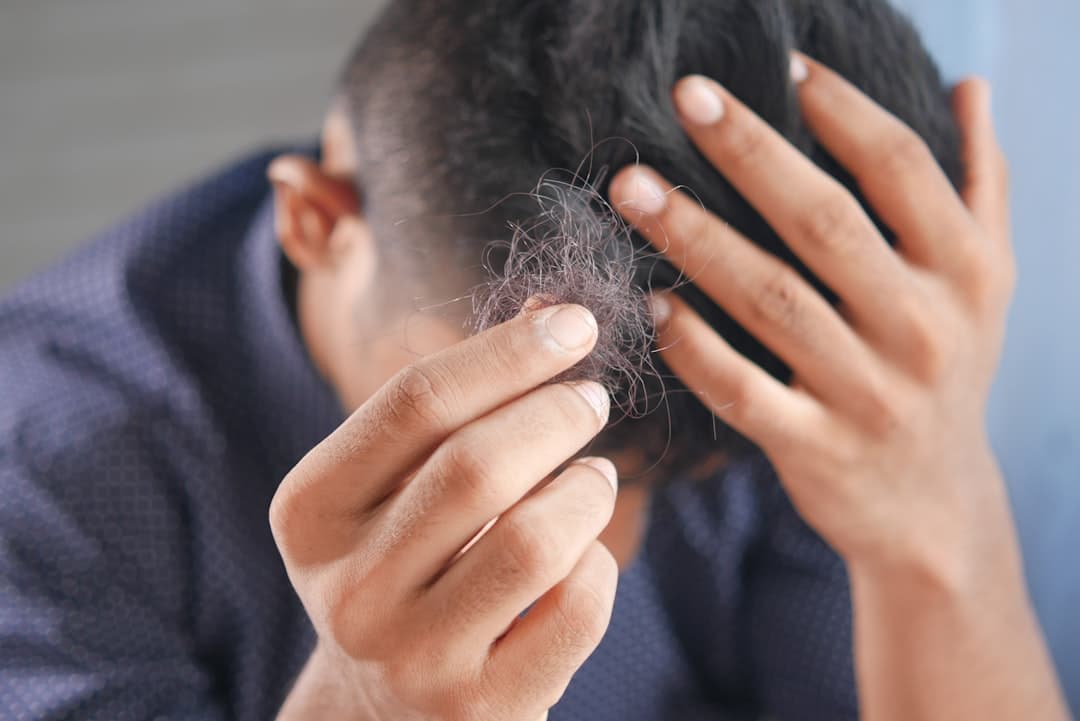
No, BPC-157 is not a hair-loss treatment in any meaningful sense. There is no peer-reviewed human evidence that BPC-157 produces hair regrowth, slows shedding in androgenic alopecia, or reverses pattern hair loss. The claim circulates in some peptide-marketing copy and forum posts, but it isn't supported by the published research.
For peptide-based hair support, GHK-Cu is the better-documented choice — and even there, the evidence is modest and the effect is supportive rather than transformative. If hair loss is your goal, established options (minoxidil, finasteride, low-level laser therapy) have substantially better evidence than any peptide approach.
Where the BPC-157 hair claim came from
A few threads feed the BPC-157 hair-loss myth:
Vascular and angiogenic effects. BPC-157 has documented pro-angiogenic activity in animal wound healing models — meaning it helps blood vessel formation in tissues being repaired. Some users extrapolate from "improves blood flow" to "should help scalp blood flow and therefore hair growth." This is mechanistic speculation, not data.
General "healing" association. BPC-157 is sometimes marketed as a generalist healing peptide. Hair loss is a tissue-level problem, so the leap to "BPC-157 should help" gets made without specific evidence.
Anecdotal forum reports. A small number of forum users have reported subjective hair improvement during BPC-157 cycles. These reports are uncontrolled, often confounded with other interventions (better sleep, diet changes, stress reduction during cycles), and don't survive scrutiny as evidence.
The Croatian research base. Most BPC-157 research comes from a single Croatian lab — see the Croatian BPC-157 problem — and even within that body of work, hair growth is not a documented endpoint. The marketing claim has outrun the science.
What peptide hair-loss treatments actually have evidence
If you want to use peptides for hair, here's the honest evidence ranking:
| Peptide | Evidence level | Mechanism | Practical fit |
|---|---|---|---|
| GHK-Cu (topical) | Moderate | Pro-follicular signaling, anti-inflammation | Adjunct to standard hair-loss care |
| GHK-Cu (injected) | Limited | Same mechanism, less local concentration | Less optimal for hair specifically |
| Thymosin beta-4 / TB-500 | Weak (animal only) | Stem cell mobilization | Speculative |
| PTD-DBM and CXXC5-related | Emerging | Wnt pathway modulation | Research-only |
| BPC-157 | None | None established | Not indicated |
| Copper peptides (non-GHK) | Some, in cosmetics | Anti-inflammatory | Cosmetic adjunct |
For depth on GHK-Cu for hair specifically see GHK-Cu for hair growth and does GHK-Cu grow hair?.
Why the difference matters
Hair loss in adult males and many women is primarily driven by androgenic alopecia — a genetic susceptibility of certain hair follicles to dihydrotestosterone (DHT). Treatments that actually work for pattern hair loss either:
- Block DHT (finasteride, dutasteride)
- Improve scalp blood flow and follicle stimulation (minoxidil)
- Use light-based stimulation (low-level laser therapy)
- Support the dermal papilla directly (some peptide and growth-factor approaches, with varying evidence)
BPC-157 doesn't touch any of these mechanisms in a clinically significant way. The angiogenic effect that's used to argue for hair benefit isn't strong enough or localized enough to address pattern hair loss at the scalp follicle level.
GHK-Cu, by contrast, has direct effects on dermal papilla cells and has been shown to support hair follicle stem cells in laboratory work — which is why it shows up in actual cosmetic hair products, not just biohacker forums.
What about hair loss caused by peptide use?
A different question: if a peptide cycle is causing hair loss, can BPC-157 help reverse it?
Some peptides — particularly IGF-1 LR3 and MK-677 at higher doses — can accelerate androgenic hair loss in susceptible users (see does IGF-1 LR3 cause hair loss? and does MK-677 cause acne?). The fix here is not BPC-157 — it's stopping the offending peptide, addressing the DHT pathway if you want to continue, and accepting that some cycle-driven loss may not fully reverse.
BPC-157 doesn't reverse pattern hair loss caused by other peptides because the underlying biology (DHT sensitivity at the follicle) is unchanged. The peptide can't out-signal the genetic susceptibility.
What to use instead
If hair loss is your concern and you want a peptide-included approach:
Established first-line treatments (not peptides):
- Topical minoxidil 5% — strong evidence base
- Oral finasteride (for men) — strong evidence base for pattern hair loss
- Low-level laser therapy devices — moderate evidence
- Address underlying contributors — thyroid status, iron, protein intake, stress
Peptide adjuncts that might help (modest):
- Topical GHK-Cu in a leave-on formulation
- Avoid peptides that worsen pattern hair loss (high-dose IGF-1 LR3, aggressive MK-677)
Approaches to avoid:
- Spending peptide budget on BPC-157 hoping for hair growth
- "Hair stack" marketing that includes BPC-157
- Topical BPC-157 formulations marketed for hair (no evidence, possible irritation)
For broader strategy see skin aging stack evidence.
The bottom line
BPC-157 is a useful peptide for tendon, ligament, and gut applications. It is not a hair-loss treatment, and the marketing that positions it as one is moving ahead of the data. If you want to address hair loss, use treatments that actually have evidence — and if you want a peptide adjunct, GHK-Cu is the right molecule, not BPC-157.